




Top 10 Perennials for Low Maintenance Gardens
Perennial gardens don’t have to be so time intensive if you choose to grow at least a few varieties that require little maintenance each season. Here are our top ten recommendations for low maintenance perennials.
One of the longest-lived perennials native to the American prairies is Baptisia, commonly known as false indigo. While most wild forms are quite tall, the Decadence series brings them down to just 2 ½-3’ tall and wide, about the size of a clump of daylilies. Now everyone can have the fun of growing false indigo, even people gardening on smaller city lots.
|
Who knew that a baby's breath could be so easy to grow? Old-fashioned varieties gave this perennial a reputation for being a hassle in the garden since they grew very large and often went dormant by late summer, leaving a big hole in the garden and limiting their value as low maintenance perennials. Festival Star is a game changer when it comes to baby’s breath. This improved selection blooms from late spring into fall without deadheading or going dormant in summer, and its shorter 12-18” height is much easier to manage. When you plant Festival Star, be sure to amend your soil if it is heavy clay since this plant needs good drainage to grow well. Plant it in a very sunny spot and let it dry out a bit before you water it again. Just like we don’t like to sit around in wet shoes, its roots don’t like to sit in wet soil for long either. Don’t forget to clip some of its fragrant blooms for your fresh or dried bouquets. New flowers will quickly take their place. Zones 3-9. |
Sweetly fragrant lavender is always a crowd pleaser, and it’s easy to see why. The rich violet purple flowers of Sweet Romance lavender bloom from early summer through fall, with new flowers appearing throughout the growing season. They are perfect for using in bouquets, sachets, sweet treats, and lemonade.
|
Planting this cultivar of our native false sunflower is an easy way to add a bright splash of gold to your landscape from midsummer into early fall for gardeners focused on easy perennial flowers. It will give you the same look as a mass of Black-Eyed Susans (Rudbeckia), but with none of the disease issues and it will even rebloom if you trim it back after the first round of flowers finishes.
|
Even if you don’t consider yourself a gardener, chances are good that you’ve recognized daylilies blooming around town in the summertim. One reason why so many people grow them is because they require almost no maintenance other than watering. They multiply reliably from year to year, are long lived, and easy to share with neighbors and friends, qualities typical of hardy low maintenance perennials.
|
Catmint is one of the most requested perennials in garden centers every year in late spring when people start seeing it bloom around town. It forms a mass of vibrant periwinkle purple flowers that is so dense, you won’t even see the foliage when it’s in bloom. Bees, butterflies and hummingbirds love catmint.
|
If you garden in shade, one of the easiest low maintenance perennials you can grow is a hosta. It’s amazing how hostas emerge from bare ground in spring and grow so quickly to fill large spaces with their elegant foliage. After the first few frosts in fall, the foliage will go dormant again until the following spring. Clean up that dead foliage in fall to help prevent slug issues the following year.
|
Cultivars of our native switch grasses are some of the easiest ornamental grasses you can grow. These durable perennials will thrive in any soil, from sand to clay, and in any moisture level, from dry to wet. The only thing they require is full sun. Prairie Winds switch grasses can be used as a low maintenance screen, hedge, background planting, or as a focal point among low maintenance garden plants in the fall landscape. Once per year in late winter or early spring before the new growth emerges, cut the entire clump of last year’s foliage back with hedge trimmers and compost it. Beyond that, no other maintenance is necessary. Zones 4-9. |
When you feel its succulent leaves, you’ll see why Rock ‘N Grow stonecrop is so drought tolerant. It stores water in its foliage and stems as a reserve, and usually doesn’t require supplemental water once the roots are established. Plant it in full sun and very well-drained soil, and do not add fertilizer or organic matter when you plant it. Lean and mean is how Sedum rolls--pamper it and you’ll be disappointed.
|
During the hottest months of summer, the cool blue flowers of Russian sage are a welcome respite in the garden. While older varieties grew much too large for most garden spaces, anyone can fit ‘Denim ‘n Lace’ in their garden. Its mature size is about 2 ½’ tall and 3’ wide. You’ll love how it forms a more dense, upright clump and is completely covered in flowers beginning in midsummer.
|

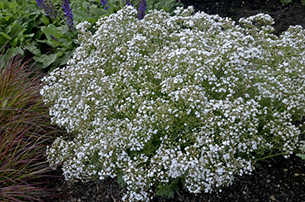 Festival Star™ Gypsophila (Baby’s Breath)
 Sweet Romance® Lavandula (Lavender)
 Rainbow Rhythm® Hemerocallis (Daylily)
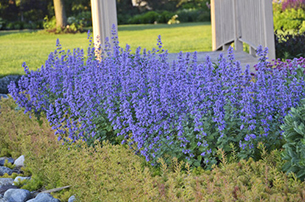 ‘Cat’s Meow’ Nepeta (Catmint)
 Shadowland® Hosta (Hosta)
 Prairie Winds® Panicum (Switch Grass)
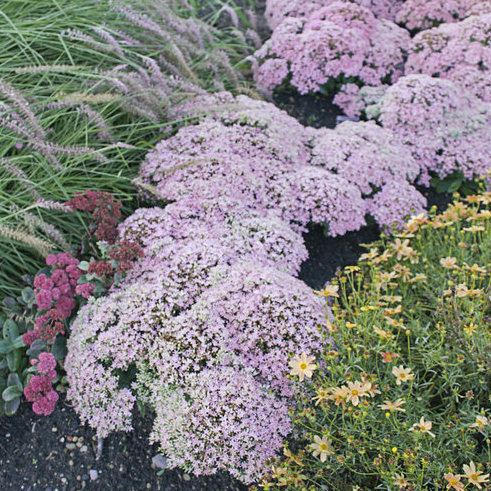 Rock ‘N Grow® Sedum (Autumn Stonecrop)
 ‘
‘Patent Info: Festival Star™ Gypsophila paniculata USPP14818 Can2631; Sweet Romance® Lavandula angustifolia USPP23001 Can4906; 'Tuscan Sun' Heliopsis USPP18763; 'Cat's Meow' Nepeta faassenii USPP24472 CanPBRAF; 'Denim 'n Lace' Perovskia atriplicifolia USPPAF CanPBRAF